
Let’s face it, teaching is exhausting. And learning how to do it is tiring on so many levels. There have been times this year where I have wanted to throw in the towel. Staying up all night writing assignments or lesson plans, feeling anxious about being watched on practicum, stressing out about finances (because you can’t do this course and work as well), fuelling up on caffeine instead of exercise and actually caring about doing a good job as well as caring about your students.
It is difficult to put yourself out there the first time – you’ve never been in front of 30 people trying to train them up for anything before. You have no idea how to do it. And the people who are helping you are also judging the hell out of you as well. No observation is entirely positive (how could you learn or make improvements if it was) and every comment or criticism can wear you down. I’ve felt eroded this year, emotionally sand-blasted, but the effect has been to chisel the archetype of the teacher out of me. I’ve had to carve off the bits that don’t fit. I’ve had to emerge from the cocoon of adulthood as a new kind of superhuman, able to also carry the emotional weight of several classrooms of humans at once, as well as myself.
It is a toughening up process. I’ve felt like I’ve been through the wringer and come out the other side much stronger and more resilient. But I haven’t loved those times where I’ve been crying on an associate teacher’s shoulder, after a particularly harrowing year 10 class, and little sleep adding an intensity I wasn’t aware was going to creep up on me during the day then leech out of my eyes straight after an intense Period 5. I’ve borrowed tissues, and other people’s stories, and wisdom, and the kindness of strangers. I’ve sometimes had to take kids outside and explain to them why I’m coming down hard on them – because their teacher required me to. I’ve learned more about myself than I ever thought possible, through my interaction with others, and holding whole classrooms up to a kind of mirror, that reflect back at you exactly where you are going wrong.
Bell (2010) writes about teaching as an emotion practice and a caring practice in Theorising Teaching (p25).
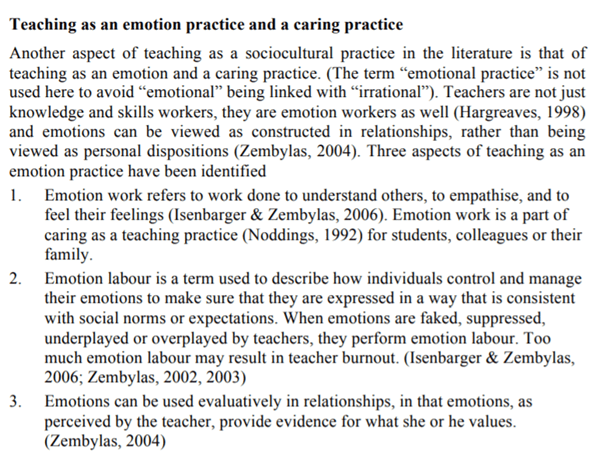
Doing this emotional work that Bell (above) describes is important for connection with students. If you have no empathy for them, and for their learning, you cannot teach effectively, as connection is a necessary foundation for engagement. Charteris & Thomas (2017) describe learning as a “social process” whereby student agency and effective learning depends on students being socially grounded in the classroom (p166). Success at school is often determined by interactions where students judge themselves based on what they think they “are capable of becoming in the teacher’s eyes” (Samu, 2015, p138) and if their teacher is not someone they can empathise with and relate to, someone they think likes them and feels they have something to offer, then how on earth can teachers engage with students effectively?
There is so much learning to be done, and that has been largely about how to turn myself into someone who can produce and maintain the space for learning for others. I’ve been busier than I’ve ever been in any other job I’ve ever had. I’ve gone from taking 4 hours to painstakingly plan a 1 hour lesson, to having a 5 minute discussion with my Associate Teacher and banging out a lesson plan in the foyer of an auditorium at interval, before teaching the lesson in Period 3. I have a lot of “off the hoof” ideas for lessons now – back-ups in case something in the classroom doesn’t work (technology), or if the class just feels a little off and a last minute change of plan is in order. I am less phased by hiccups now; I’ve become so much more confident in front of a classroom.
But the thing that has really changed for me is caring so much about the students – not only their learning in my classroom, but their general development, how they view the world, what’s on top for them in their day to day running, where they want to be and how I can help them and not get in their way. I understood this is something I would bring to teaching but I didn’t know how deeply I would care about the students or the job. Like parenting, where you think there is no way you can love a child any more than when they are born and then you discover that every day brings a deeper love, more knowledge, more resilience and care and attention than you’ve ever mustered before. My children developed me as a parent. My students are helping to develop me as a teacher.
Trial and error seems to be the best way to learn to be a teacher. Every practicum teaching becomes easier but the more you are given chances to mess things up, the better. Those bad lessons are the best teachers. You need time to reflect on those, to figure out a new plan, better ways of achieving what you set out to do. Associate teachers that believe there is only one way of doing things are poisonous to your own development. Associate teachers that allow you to figure stuff out on your own, try and fail (or succeed), to find your own feet and your own way of doing things, are like GOLD.
References:
Bell, B. (2010). Theorising Teaching. Waikato Journal of Education, 15(2), 21–40. https://doi-org.ezproxy.aut.ac.nz/10.15663/wje.v15i2.111
Charteris, J., & Thomas, E. (2017). Uncovering ‘unwelcome truths’ through student voice: teacher inquiry into agency and student assessment literacy. Teaching Education, 28(2), 162. Retrieved from http://search.ebscohost.com.ezproxy.aut.ac.nz/login.aspx?direct=true&db=edb&AN=121255754&site=eds-live
Samu, T. W. (2015). The “Pasifika Umbrella” and quality teaching: Understanding and responding to the diverse realities within. Waikato Journal of Education (2382-0373), 129–140. Retrieved from http://search.ebscohost.com.ezproxy.aut.ac.nz/login.aspx?direct=true&db=anh&AN=115717256&site=eds-live
**Image from: https://jesshall.co/2015/04/22/teacher-talk-003-8-things-i-wish-i-knew-as-a-first-year/


 Wild Fishing in a Sea of Provocations
Sanna,
You express exactly how this year has been for me, too. I knew teachers put a lot of time into lesson planning and I knew I’d need to spend a fair bit of time re-learning the science, but I hadn’t anticipated how emotionally draining teaching would be. It shouldn’t come as a surprise, of course, that a job dealing with other human beings can be truly exhausting. Having worked in a school for several years, I thought I’d have quite a good grasp on that! It’s only when you are face to face with a classroom full of students for a whole day that it really sinks in the responsibility you have for their well-being as well as their learning. It almost seems ridiculous that anyone could entrust us with such huge responsibility! Like you, I’ve learned a huge amount from my good ATs and I’ve actually learned plenty from the ‘less than good’ one, about the kind of teacher I don’t want to be.
I completely agree that the caring and emotional practices of teaching are the crux of the job. You and I fortunate to be embarking on this crazy profession after many years following other paths – I think we can use to our advantage our wealth of experience working out how other humans work.
Mandy
LikeLike
Love the honesty Tania, you’re right…teaching is exhausting. I know I’m definitely exhausted from a full-on year!
Do the feelings of fulfilment and accomplishment within the profession outweigh the reality of exhaustion? That’s something I’ve been considering this year. Is it worth all the time, energy and effort? I believe so, I love the feeling of joy and fulfilment when I student learns something new. I think that extreme levels of exhaustion can be avoided through teachers learning to work smarter, not harder. How can we improve our efficiency so that we use less time to prepare our lessons? This is something I’ve been working out in preparation for next year!
Challenging point you mentioned about how the classroom can hold up a mirror that reflects back at you what you are doing wrong. Often when the class is overly disruptive it can be a reflection on the teacher’s ability to effectively manage the students. Are my behaviour management strategies effective enough? Am I too soft? Do I need to enforce more rules? These were some of the questions I asked myself on practicum when I was faced with the challenge of teaching boisterous classes. I think we need to ensure we are committed to continuously improving and adapting the way we do things. However, I also believe that we can’t be too hard on ourselves and at the end of the day we cannot take the full responsibility for the way students behave or whether or not they are completing their work.
Connection is essential for engagement-love this point. I remember when I was in school, my level of engagement within my different classes was heavily influenced by the level of connection I felt with the teacher, whether they were interested in me as a student. I aim to be a teacher who makes it a priority to connect with the students that I teach.
LikeLiked by 1 person