
http://www.voicesofeastanglia.com/2011/12/seventies-classroom-posters.html
A few years prior to starting my teacher’s training I was working in two part-time jobs that were both growing. I convinced both of my managers that they needed me for longer hours and both offered me full-time contracts. The pay was quite similar but in the end I chose the job that had it’s own office (not a modern one either) over an open plan space with dividers. I was the only person in the open plan office doing close computer work (accounting and funding administration) and reconciliations and budgeting that required a reasonably quiet head space. I had seen what it was like to work in both and having PR and marketing people shooting the breeze across the partitions near my desk while I tried to do “actual” work really pissed me off. The boss also insisted on playing very bad radio in the space, and no earphones in the world could drown her bad taste in music out. In the job I eventually took, I had an office with four walls that I could decorate my own way. A door I could shut. A productive space to call my own. The old job replaced me with two employees working a combined total of 58 hours, when I had been getting the job done in 24, with crappy headphones and a lot of stress. My new office made me happy – I felt more comfortable and less exposed to distractions – and I didn’t have to come to work every day and be grumpy with my co-workers. In fact, people came to me, and did lots of chatting in my doorway, which I never minded, when my door was open.
But schools are different these days, and a teacher can’t always be certain of having their own classroom, with 30 or so students contained within it, and sense of control over the way the space is shaped. Enter the Innovative Learning Environment:
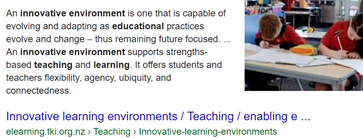
In New Zealand, Modern Learning Environments are all the rage. According to McPhail “these spaces are suggestive of student-centred pedagogy, where learners are able to move around freely, connect with each other and with the teacher, and to access the Internet as required by the context and demands of the learning” but some teachers (including me) sometimes find it difficult to work in spaces with lots of glass and hard noisy surfaces, that open out into larger areas, that provide even more distractions for learners and genuinely present as a problem for sensitive students (learners on the Autism spectrum for example, or the hearing impaired) because these spaces can be overwhelming and do not make introverts like me feel safe or comfortable.
On a recent practicum I was located in a glass walled classroom that was entered from an elevated mezzanine walkway over a large atrium space – a modern new building within an older school environment – when a lock down practice occurred. If there was a gunman on the walkway outside that room, and we were under the desks, he would be able to see us all as if we were on a stage with the fourth wall of glass enabling his total viewing pleasure. There was a coloured pattern over the bottom part of the glass but unless the gunman was a midget that would have proved no difficulty whatsoever. Locking the doors wasn’t going to do much good – unless that glass was bulletproof. (And, to be honest, the school wasn’t that great with the maintenance anyway, and of the two glass doors – an opening door and a slider – only one of them could be properly locked anyway). The only space to hide was a tiny nook in the corner behind the teachers desk, on the front left side of the room.
The teacher in that room obviously liked a more traditional kind of order as she still put her modern furniture in horizontal rows, with the lower desks in the middle of the room and the higher desks on two vertical rows, that flanked the bank of lower desks in the middle. There was a projector that could be aimed at the whiteboards which took up the whole “front” of the classroom and slid across a significant amount of useful storage space. There was also a large screen TV on the right of the whiteboards, which was used more often than the projector, but with literally the same purpose. It was not a space designed for collaboration, but it was hellishly modern, and because of the hard surfaces, I actually found that sometimes I had to watch the student talking to me across the room, and attempt to lip-read, because even though no-one else was talking, the sound reverberated in the space and it felt like I was losing my hearing.
I think schools are toying with the idea of MLE’s and not using the spaces in the ways that they were originally intended. And whether you like it or not, teachers will find ways to subvert the new initiatives anyway, if they don’t suit their personal style of teaching.
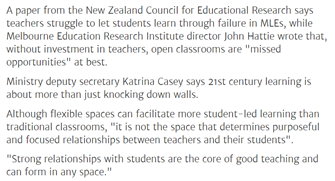
I agree that strong relationships with students are the cornerstone for learning. And like Smardon & Charteris (2016) I believe learning can take place anywhere:
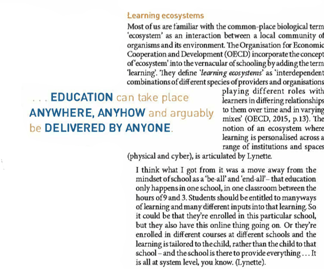
I’m not as sold on the physical structure of the buildings or the furniture. I see Innovative Learning Environments as a much bigger concept than modern classrooms though. I think innovation should be more lateral – that we need to re-think it entirely. There needs to be a major shift, not a half arsed attempt at change, with a mix of the old and the new.
Take a look at this video which talks about taking education out of the traditional classroom – not as a class trip – and into the wider community:
The aquarium idea is truly collaborative – and by NZ standards, much more innovative than changing the furniture (although I know my friend Sanna would disagree, with her Finnish background and her experience of a different kind of progressive education). The aquarium as classroom idea is also student centred and totally personalised. And while it takes the teacher almost out of the picture, if I think back to my own learning, I would have highly valued this as high school student – quiet time to sit down and observe and record my reflections in a non-school environment. (I do this myself, as an adult, in art galleries and museums, as inspiration for writing poetry or creating art. I’d have loved to have had this opportunity in my teens).
So, while I’m all in favour of collaboration and wider community involvement in learning, I’m not such a fan of the distracting open spaces in a school that is still run by blocks of classes delivered in time to meet bells and a structured linear curriculum system – after all, you never see an examination hall set up in a way that mimics an Innovative Learning Environment. Think about this – if all the single cell desks are turfed out, how would a school even run an NZQA exam? Would it be one big group desk per person, to avoid cheating and distraction? Has anybody thought this stuff through?
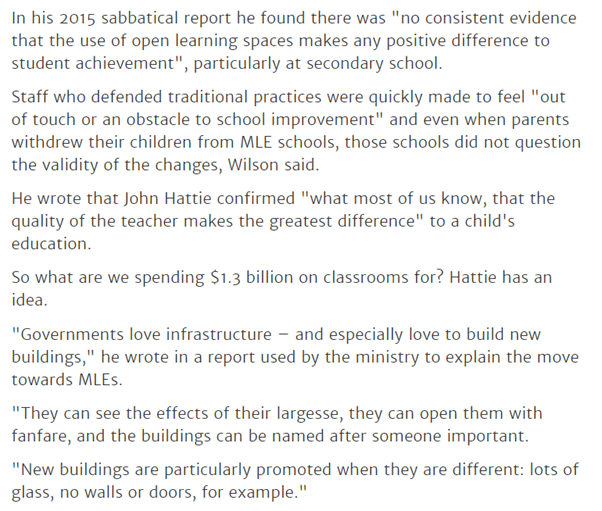
I agree with Hattie, above, about the “largesse” – and the government being “seen” to fix things that are much larger and more complex problems than the space in which they are apparently happening.
But like Urlich (2015) points out “it is not the spaces that are important, but the teaching and learning practice that is. Poor learning will happen in a fantastic classroom with all the modern bells and whistles if the teaching is incompetent. Likewise, a fantastic teacher under a tree will produce results”. These new environments are still very dependent on the people that inhabit them – schools still need effective teachers that inspire and engage their students to learn and be successful.
REFERENCES:
MCPHAIL, G. (2015). Conceptual Progression in Innovative Learning Spaces. New Zealand Journal of Teachers’ Work, Vol 12, Issue 1, 6-8
SMARDON, D., & CHARTERIS, J. (2016). KNOCKING DOWN WALLS AND BUYING NEW FURNITURE? What are Innovative Learning Environments in NZ schools really about? New Zealand Principals’ Federation Magazine, 31(1), 24–26. Retrieved from http://search.ebscohost.com.ezproxy.aut.ac.nz/login.aspx?direct=true&db=anh&AN=138929598&site=eds-live
URLICH, N. (2015). Changing Learning Environments for a Changing Workplace. New Zealand Journal of Teachers’ Work, Vol 12, Issue 1, 4-5


 Wild Fishing in a Sea of Provocations
Hi Tania,
Insightful blog, I enjoy the way that you outline some of your critiques about MLE’s/ILE’s and in particular how you discuss your perspective on how projects that push these sorts of classrooms can be a kind of glory for the sake of glory project at school board/government levels. The idea that some of these initiatives are change just for the sake of change was an idea many in our cohort had sympathy towards.
I am also somewhat pessimestic about ILE’s, however the main thing benefit I see from them is that they allow for a greater level of flexibility in terms of teaching methodologies. In most situations you can still teach traditionally if that suits your particular style of teaching, indeed our class was still largely set up in traditional ways despite the “modern” furniture. Traditional classrooms can be restrictive for certain types of educational strategies which can limit teachers and most importantly student learning.
In terms of the lack of noticable benefit, I feel its probably too soon to tell. Pedagogies are still being adjusted towards these sorts of classrooms and in general we are seeing a strong push to incorporate modern learning techniques. Some have adjusted to these, some will adjust, some will not. However, over time these classrooms and methods will likely become second-nature to educators and students. This is when we will be able to judge the success or failure of these initiatives.
One of my concerns that wasn’t really discussed however is how ILE’s can almost turn into “panopitcons” where everyone is watching everyone, and the impact this can have on both student and teacher behaviour. I worry about how willing some students would fret about presenting their work in some forms of ILE’s where everybody can see what they are doing. Furthermore, will teachers be as willing to take risks when everyone can see if it goes badly? Will we limit our future progress because of this? I guess we will see!
Cheers,
Corey
LikeLike
Hi Tania,
Thank you for your in-depth and insightful blog. It is really interesting to hear about your experiences of wider-open work spaces versus single-cell offices, and how your time spent in these spaces can be related to similar spaces as classrooms. It makes me think of the idea that ILE classrooms are starting to look a lot like open-plan office spaces, and the comparison photos we saw in class of an ILE versus a business! I can see how the ILE did not work for the class you were in on placement, however I wonder, did you have a chance to observe a different teacher in a similar space, and, if so, were they also using this set-up in a traditional teacher-at-the-front, desks-in-rows sense? I wonder how that space would work if it were set up for collaboration and project-based learning? Although your point regarding glass walls and noise bouncing is very astute – I imagine group work would make it very hard to hear! That seems like something the architects forgot to consider! I myself do not necessarily agree with ILE’s – I do think that they can work well, with a good teacher who is teaching to make the most of the space, knows how to use it effectively, and whose pedagogy suits the space. However, I do not see why collaboration and project-based learning cannot happen in a single-celled classroom, which I think has more options (due to the possibility of a closed door and smaller numbers) for a variety of pedagogies, modern or otherwise, to suit the teacher! I have personally taught this way in a single-celled classroom with single desks and have had no problems! I would be very interested to see how this school functioned!
Many thanks for your time and thoughts,
Anna
LikeLike