“As any practising teacher is aware, both initial teacher education and subsequent registration and appraisal processes require individuals to provide evidence of the ways they are operationalising biculturalism. This can be challenging for teachers because, despite the familiarity of the term, there is not a consensus about what biculturalism means, especially at the level of individual practice”.
Megan Lourie (2015)

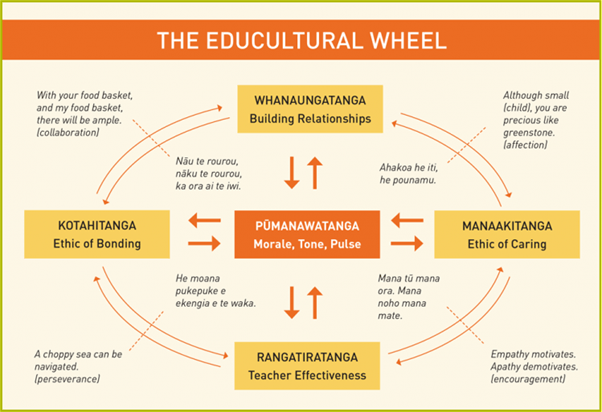
Recognising biculturalism in education requires some planning around how to make sure Maori principles are included in our classrooms, without being seen to be tokenistic, but as a genuine response to the Treaty of Waitangi. The Educultural Wheel below, shows some broad ways that kaupapa Maori can be included in education, and how each of these strands are connected to create a connected whole:
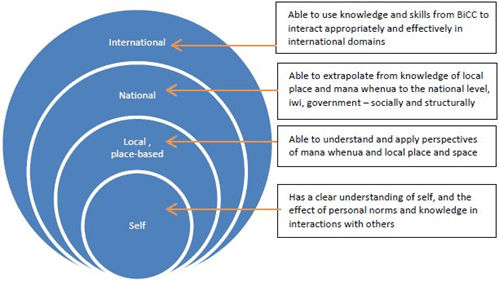
In order for teachers to become biculturally competent and confident (BiCC in the diagram below) we need to think of ourselves and wider society and how our commitment to the bicultural aims of the Treaty of Waitangi are represented in NZ education. It starts with the self at the centre of the equation then radiates out to the local community (classroom), nationally and internationally.
In the classroom Whanaungatanga might look like reaching out to whanau and caregivers and keeping them informed of a student’s progress. Keeping everybody in the loop. Manaakitanga might be as simple as getting Maori place and student names right – saying words correctly – and also including Te Reo words for commonly used items in the classroom (for example, having the date in Maori on your classroom whiteboard each day, using Maori greetings, encouraging the use of Te Reo in general conversations/korero). Rangatiratanga relates back to managing self and allowing the student to have sovereignty over their learning. This would also include recognising the cultural capital every student brings into the room with them and honouring their individual world view. Kotahitanga could look like reflecting on our place in the world and how we bond with others, within that space. It might mean working together in groups to achieve common goals and recognising our collective mahi.
On my last practicum I saw hardly any Maori being used in the classroom. I wondered if this special character school (catholic) might have found it difficult to weave a religious application through the curriculum as well as attempting to also weave biculturalism in too. The only place where I saw students use Te Reo in a formal way at school, was when they were doing the sign of the cross, in a whole school assembly. I had never seen any of the teachers do it in staff meetings where prayers were said at all. What interested me about this is that it is obviously being modelled in Religious Education to the students, but teachers (in this school) were not embracing it that much themselves.
On other placements I have seen some teachers make a large effort to name items in their classroom with Te Reo and use as much Te Reo as possible in their instruction. Repetition of Maori words in the classroom (eg korero, mahi, greetings etc) are a helpful way for me (a white Australian woman) to feel like I am engaging with biculturalism. But I think I have a long way to truly incorporate this into my practice.
 Wild Fishing in a Sea of Provocations