“As any practising teacher is aware, both initial teacher education and subsequent registration and appraisal processes require individuals to provide evidence of the ways they are operationalising biculturalism. This can be challenging for teachers because, despite the familiarity of the term, there is not a consensus about what biculturalism means, especially at the level of individual practice”.
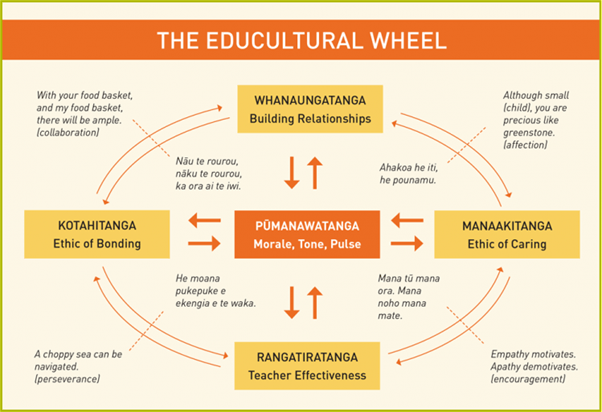
Recognising biculturalism in education requires some planning around how to make sure Maori principles are included in our classrooms, without being seen to be tokenistic, but as a genuine response to the Treaty of Waitangi. The Educultural Wheel below, shows some broad ways that kaupapa Maori can be included in education, and how each of these strands are connected to create a connected whole:
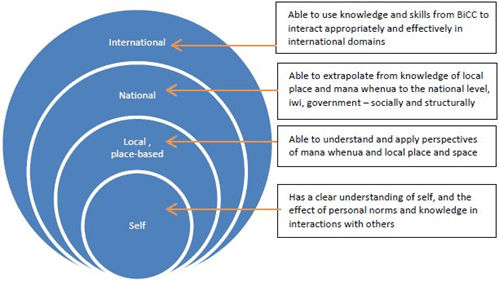
In order for teachers to become biculturally competent and confident (BiCC in the diagram below) we need to think of ourselves and wider society and how our commitment to the bicultural aims of the Treaty of Waitangi are represented in NZ education. It starts with the self at the centre of the equation then radiates out to the local community (classroom), nationally and internationally.
In the classroom Whanaungatanga might look like reaching out
to whanau and caregivers and keeping them informed of a student’s progress.
Keeping everybody in the loop. Manaakitanga might be as simple as getting Maori
place and student names right – saying words correctly – and also including Te
Reo words for commonly used items in the classroom (for example, having the
date in Maori on your classroom whiteboard each day, using Maori greetings,
encouraging the use of Te Reo in general conversations/korero). Rangatiratanga
relates back to managing self and allowing the student to have sovereignty over
their learning. This would also include recognising the cultural capital every
student brings into the room with them and honouring their individual world
view. Kotahitanga could look like reflecting on our place in the world and how
we bond with others, within that space. It might mean working together in
groups to achieve common goals and recognising our collective mahi.
On my last practicum I saw hardly any Maori being used in
the classroom. I wondered if this special character school (catholic) might
have found it difficult to weave a religious application through the curriculum
as well as attempting to also weave biculturalism in too. The only place where
I saw students use Te Reo in a formal way at school, was when they were doing
the sign of the cross, in a whole school assembly. I had never seen any of the teachers
do it in staff meetings where prayers were said at all. What interested me about
this is that it is obviously being modelled in Religious Education to the
students, but teachers (in this school) were not embracing it that much themselves.
On other placements I have seen some teachers make a large
effort to name items in their classroom with Te Reo and use as much Te Reo as
possible in their instruction. Repetition of Maori words in the classroom (eg
korero, mahi, greetings etc) are a helpful way for me (a white Australian woman)
to feel like I am engaging with biculturalism. But I think I have a long way to
truly incorporate this into my practice.
A few years prior to starting my teacher’s training I was working in two part-time jobs that were both growing. I convinced both of my managers that they needed me for longer hours and both offered me full-time contracts. The pay was quite similar but in the end I chose the job that had it’s own office (not a modern one either) over an open plan space with dividers. I was the only person in the open plan office doing close computer work (accounting and funding administration) and reconciliations and budgeting that required a reasonably quiet head space. I had seen what it was like to work in both and having PR and marketing people shooting the breeze across the partitions near my desk while I tried to do “actual” work really pissed me off. The boss also insisted on playing very bad radio in the space, and no earphones in the world could drown her bad taste in music out. In the job I eventually took, I had an office with four walls that I could decorate my own way. A door I could shut. A productive space to call my own. The old job replaced me with two employees working a combined total of 58 hours, when I had been getting the job done in 24, with crappy headphones and a lot of stress. My new office made me happy – I felt more comfortable and less exposed to distractions – and I didn’t have to come to work every day and be grumpy with my co-workers. In fact, people came to me, and did lots of chatting in my doorway, which I never minded, when my door was open.
But schools are different these days, and a teacher can’t always be certain of having their own classroom, with 30 or so students contained within it, and sense of control over the way the space is shaped. Enter the Innovative Learning Environment:
In New Zealand, Modern Learning Environments are all the rage. According
to McPhail “these spaces are suggestive of student-centred pedagogy, where
learners are able to move around freely, connect with each other and with the
teacher, and to access the Internet as required by the context and demands of
the learning” but some teachers (including me) sometimes find it difficult to
work in spaces with lots of glass and hard noisy surfaces, that open out into
larger areas, that provide even more distractions for learners and genuinely
present as a problem for sensitive students (learners on the Autism spectrum
for example, or the hearing impaired) because these spaces can be overwhelming
and do not make introverts like me feel safe or comfortable.
On a recent practicum I was located in a glass walled classroom
that was entered from an elevated mezzanine walkway over a large atrium space –
a modern new building within an older school environment – when a lock down
practice occurred. If there was a gunman on the walkway outside that room, and
we were under the desks, he would be able to see us all as if we were on a
stage with the fourth wall of glass enabling his total viewing pleasure. There
was a coloured pattern over the bottom part of the glass but unless the gunman
was a midget that would have proved no difficulty whatsoever. Locking the doors
wasn’t going to do much good – unless that glass was bulletproof. (And, to be
honest, the school wasn’t that great with the maintenance anyway, and of the
two glass doors – an opening door and a slider – only one of them could be
properly locked anyway). The only space to hide was a tiny nook in the corner
behind the teachers desk, on the front left side of the room.
The teacher in that room obviously liked a more traditional kind
of order as she still put her modern furniture in horizontal rows, with the
lower desks in the middle of the room and the higher desks on two vertical
rows, that flanked the bank of lower desks in the middle. There was a projector
that could be aimed at the whiteboards which took up the whole “front” of the
classroom and slid across a significant amount of useful storage space. There
was also a large screen TV on the right of the whiteboards, which was used more
often than the projector, but with literally the same purpose. It was not a
space designed for collaboration, but it was hellishly modern, and because of
the hard surfaces, I actually found that sometimes I had to watch the student
talking to me across the room, and attempt to lip-read, because even though
no-one else was talking, the sound reverberated in the space and it felt like I
was losing my hearing.
I think schools are toying with the idea of MLE’s and not using the spaces in the ways that they were originally intended. And whether you like it or not, teachers will find ways to subvert the new initiatives anyway, if they don’t suit their personal style of teaching.
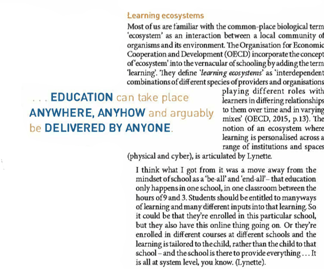
I agree that strong relationships with students are the cornerstone for learning. And like Smardon & Charteris (2016) I believe learning can take place anywhere:
I’m not as sold on the physical structure of the buildings or the
furniture. I see Innovative Learning Environments as a much bigger concept than
modern classrooms though. I think innovation should be more lateral – that we
need to re-think it entirely. There needs to be a major shift, not a half arsed
attempt at change, with a mix of the old and the new.
Take a look at this video which talks about taking education out of the traditional classroom – not as a class trip – and into the wider community:
The aquarium idea is truly collaborative – and by NZ standards, much more innovative than changing the furniture (although I know my friend Sanna would disagree, with her Finnish background and her experience of a different kind of progressive education). The aquarium as classroom idea is also student centred and totally personalised. And while it takes the teacher almost out of the picture, if I think back to my own learning, I would have highly valued this as high school student – quiet time to sit down and observe and record my reflections in a non-school environment. (I do this myself, as an adult, in art galleries and museums, as inspiration for writing poetry or creating art. I’d have loved to have had this opportunity in my teens).
So, while I’m all in favour of collaboration and wider community involvement in learning, I’m not such a fan of the distracting open spaces in a school that is still run by blocks of classes delivered in time to meet bells and a structured linear curriculum system – after all, you never see an examination hall set up in a way that mimics an Innovative Learning Environment. Think about this – if all the single cell desks are turfed out, how would a school even run an NZQA exam? Would it be one big group desk per person, to avoid cheating and distraction? Has anybody thought this stuff through?
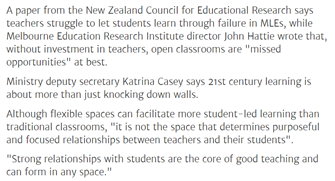
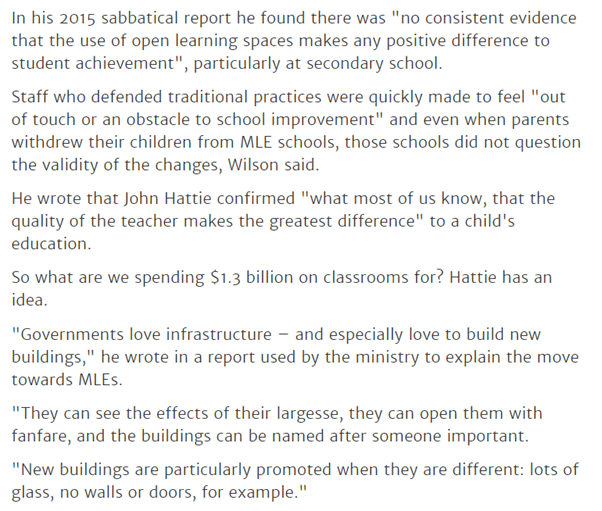
I agree with Hattie, above, about the “largesse” – and the
government being “seen” to fix things that are much larger and more complex
problems than the space in which they are apparently happening.
But like Urlich (2015) points out “it is not the spaces that are important, but the teaching and learning practice that is. Poor learning will happen in a fantastic classroom with all the modern bells and whistles if the teaching is incompetent. Likewise, a fantastic teacher under a tree will produce results”. These new environments are still very dependent on the people that inhabit them – schools still need effective teachers that inspire and engage their students to learn and be successful.
REFERENCES:
MCPHAIL, G. (2015). Conceptual Progression in Innovative Learning Spaces. New Zealand Journal of Teachers’ Work, Vol 12, Issue 1, 6-8
Let’s face it, teaching is
exhausting. And learning how to do it is tiring on so many levels. There have
been times this year where I have wanted to throw in the towel. Staying up all
night writing assignments or lesson plans, feeling anxious about being watched
on practicum, stressing out about finances (because you can’t do this course
and work as well), fuelling up on caffeine instead of exercise and actually
caring about doing a good job as well as caring about your students.
It is difficult to put yourself
out there the first time – you’ve never been in front of 30 people trying to
train them up for anything before. You have no idea how to do it. And the
people who are helping you are also judging the hell out of you as well. No
observation is entirely positive (how could you learn or make improvements if
it was) and every comment or criticism can wear you down. I’ve felt eroded this
year, emotionally sand-blasted, but the effect has been to chisel the archetype
of the teacher out of me. I’ve had to carve off the bits that don’t fit. I’ve
had to emerge from the cocoon of adulthood as a new kind of superhuman, able to
also carry the emotional weight of several classrooms of humans at once, as
well as myself.
It is a toughening up process.
I’ve felt like I’ve been through the wringer and come out the other side much
stronger and more resilient. But I haven’t loved those times where I’ve been
crying on an associate teacher’s
shoulder, after a particularly harrowing year 10 class, and little sleep adding
an intensity I wasn’t aware was going to creep up on me during the day then
leech out of my eyes straight after an intense Period 5. I’ve borrowed tissues,
and other people’s stories, and wisdom, and the kindness of strangers. I’ve
sometimes had to take kids outside and explain to them why I’m coming down hard
on them – because their teacher required me to. I’ve learned more about myself
than I ever thought possible, through my interaction with others, and holding
whole classrooms up to a kind of mirror, that reflect back at you exactly where
you are going wrong.
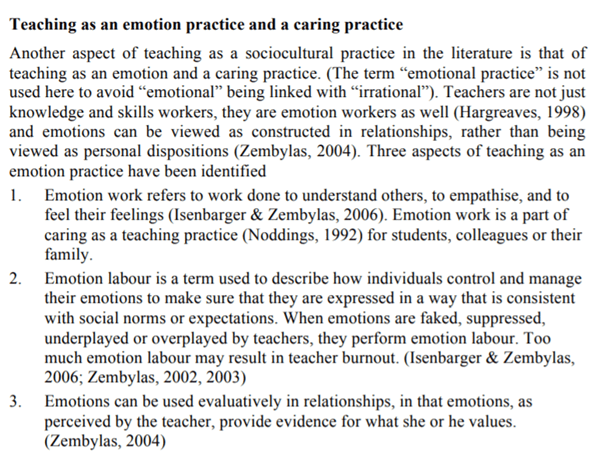
Bell (2010) writes about teaching as an emotion practice and a caring practice in Theorising Teaching (p25).
Doing this emotional work that
Bell (above) describes is important for connection with students. If you have
no empathy for them, and for their learning, you cannot teach effectively, as
connection is a necessary foundation for engagement. Charteris & Thomas
(2017) describe learning as a “social process” whereby student agency and
effective learning depends on students being socially grounded in the classroom
(p166). Success at school is often
determined by interactions where students judge themselves based on what they
think they “are capable of becoming in the teacher’s eyes” (Samu, 2015, p138)
and if their teacher is not someone they can empathise with and relate to, someone
they think likes them and feels they have something to offer, then how on earth
can teachers engage with students effectively?
There is so much learning to be
done, and that has been largely about how to turn myself into someone who can
produce and maintain the space for learning for others. I’ve been busier than
I’ve ever been in any other job I’ve ever had. I’ve gone from taking 4 hours to
painstakingly plan a 1 hour lesson, to having a 5 minute discussion with my
Associate Teacher and banging out a lesson plan in the foyer of an auditorium
at interval, before teaching the lesson in Period 3. I have a lot of “off the
hoof” ideas for lessons now – back-ups in case something in the classroom
doesn’t work (technology), or if the class just feels a little off and a last
minute change of plan is in order. I am less phased by hiccups now; I’ve become
so much more confident in front of a classroom.
But the thing that has really
changed for me is caring so much about the students – not only their learning
in my classroom, but their general development, how they view the world, what’s
on top for them in their day to day running, where they want to be and how I
can help them and not get in their way. I understood this is something I would
bring to teaching but I didn’t know how deeply I would care about the students
or the job. Like parenting, where you think there is no way you can love a
child any more than when they are born and then you discover that every day
brings a deeper love, more knowledge, more resilience and care and attention
than you’ve ever mustered before. My children developed me as a parent. My
students are helping to develop me as a teacher.
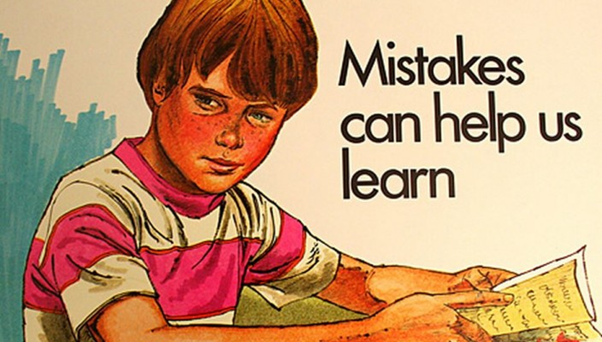
Trial and error seems to be the
best way to learn to be a teacher. Every practicum teaching becomes easier but
the more you are given chances to mess things up, the better. Those bad lessons
are the best teachers. You need time to reflect on those, to figure out a new
plan, better ways of achieving what you set out to do. Associate teachers that
believe there is only one way of doing things are poisonous to your own
development. Associate teachers that allow you to figure stuff out on your own,
try and fail (or succeed), to find your own feet and your own way of doing
things, are like GOLD.
In a recent lecture on Sexuality and Gender one of our own teaching cohort made what she thought was a valid point – that sex sells, and that she gets more tips at work when she hikes her skirt up and wears a push up bra. This surprised me, not only because I thought the youth of today were more informed than I was at school, but also because clearly the feminist messaging around this is not getting through to young people at risk.
But that got me thinking about other things – particularly porn. Margaret Atwood predicted the pornification of our culture in The Handmaids Tale (published in 1985, two years after I left high school) a text that has made a resurgence because of the hit Hulu adaptation and it’s chilling resonance for citizens (particularly feminists) in Trump era politics in the USA. In fictional Gilead, the new totalitarian state has overthrown the government of a world where pornomarts existed on every street corner.
While we don’t have shops that sell porn on every street corner today, there is an explosive amount of pornographic content on the internet that is easily accessible by teenagers, who are not only curious about their own sexuality, but derive most of their information about sex and sexuality from possibly unreliable sources. Teenagers don’t generally ask their parents for information about sex beyond the awkward “What is Happening to Me?” pre-teen conversations or later uncomfortable discussions about daughters going on the pill, or boys or girls protecting themselves from diseases and unwanted teen pregnancies. According to Lerza (2018, p23) “kids engage with and through technology as much if not more than they engage face-to-face with actual, in-the-flesh people”.
“Other research tells us that 12 percent of all websites are pornographic, 25 percent of all search engine requests are porn-related, and 35 percent of all downloads involve pornography (Damania, 2011). Shall I put these numbers in context for you? Netflix has 46 million monthly users. Amazon has 110 million monthly users. Twitter has 160 million monthly users. Porn sites have 450 million monthly users. That is more than Netflix, Amazon, and Twitter combined. And that does not include all the people who send and receive sexts, or the people who cruise hookup apps, dating sites, and social media looking for erotic content”. (Lerza, 2018, p23)
But the trouble with porn is not just about easy accessibility, but also about content. What is depicted in more recent pornography is often extreme and graphic and gives teenagers false ideas about acceptable consenting behaviour in the bedroom. Pornographic sites on the internet highlight sex acts that few teens and many adults are unlikely to have performed, in a normal developing relationship. Teenage girls are being pressured into more violent acts (eg anal sex or sadomasochistic acts) by boys who are fuelled by pornographic imagery, who are unable to discriminate between sexual role play and acts that are intended to hurt or humiliate. Acts that are designed to degrade create a power imbalance, and this is what needs to be addressed.
Girls are also under pressure to appear like models in porn imagery – feeling that it is necessary to be fully shaven, thin and gym toned, busty, perfectly groomed and spray tanned – and that need to compete means taking dubious selfies in very little clothing and distributing images of themselves that they may regret later in their lives. Images do not delete themselves – and remain held in the cloud of the internet forever.
Research suggests porn fries the brains of those who use it
regularly, with parts of the brain lighting up the minute pornographic images
are viewed. These light-up pathways send chemicals to the body that are extremely
addictive. The more the brain craves pornography, the more extreme the
pornography needs to be to satisfy it. Which is a problem for teens, and
whether you like it or not, it is also a problem for teachers. In a recent study
it was found that 96 percent of 16 year old teenage boys watched porn daily (Lerza,
2018, p24) and the consequences of this are phenomenal. Porn addiction,
especially with a daily hit rate, encourages “preoccupation, loss of control
over use, and directly related negative consequences” (p25) that create
problems with sexual activity and relationships including:
depression
low self-esteem
isolation and loneliness
anxiety
inability to form or maintain romantic
relationships
trouble in school or at work
stressful relationships at home
concurrent abuse of alcohol and/or drugs
Like it or not, even though porn may not present as a problem, in itself, in the classroom, it has consequences that affect the teenagers we work with every day. It is not an issue that is going to go away. Some would argue that it isn’t a teacher’s job to address this problem but surely if we have to deal with trying to educate the porn-addled teenage brain, something needs to be done? Since all solutions start with framing questions about problems, it might be good to have some open and frank discussions. As an English teacher I see it as part of my job description to have the guts and gall to talk about these issues, openly, with students, and to treating teenagers (and their education) with the intelligence, respect and care they each deserve.
” Our world today is riddled with anger and grievances linked to feelings of injustice and inequality. Whether perceived or real, economic, cultural or political, inequalities underpin many movements that use violence to achieve their aims. Education systems can fuel these grievances or reduce them. ” Novelli ( 2016)
In his video above, Nish Kumar responds to the western world’s common response of “immigrants are taking our jobs” etc by citing research that indicates that immigrants are more likely to bring more money into countries they migrate to, and pay more taxes.
Humans are not a profit and loss statement and education should be equal for everyone. Novelli (2010) states that ” we need to go beyond seeing children as human capital and instead see them holistically in their multiple economic, cultural, political and social manifestations”.
NZ accepts around 1000 refugees into its borders every year. These Afghan, Bhutanese, Colombian, Congolese, Ethiopian, Iraqi, Myanmarese/Burmese, Somali, Sudanese and Syrian refugees often arrive after spending many years in refugee camps. They arrive with their own languages and sometimes have had very little in the way of formal education, and refugee students will have fallen behind students of their own age who are native New Zealanders because of these barriers to their learning (as well as having English as their second language).
I recently had the pleasure of teaching a year 9 Syrian refugee boy who had been living in NZ for four years with his family. I was on practicum during the time this class were working on a speech unit, and he was planning a poem he could use as a spoken word presentation. When I asked him what he was writing about he spoke very softly and smiled as he said his poem was about being kind to each other. On reading his work (and helping him organise his thoughts into a poem shape) it was clear that what he was trying to address was school bullying (on a micro scale) and war (on a macro scale). His subject was bullying and war, but he was trying to tell all of his classmates (as he would be presenting it to the class) that the way to overcome this was kindness and being loving towards each other.
This was quite heartbreaking and heartwarming at the same time. It also started off a brief conversation before the bell went, where he mentioned that when he grew up he would like to go and see his older brother, who didn’t move to New Zealand, but had gone to America instead. He had had an opportunity to move there, before his family got placed in New Zealand. I couldn’t imagine how difficult and traumatic it must have been, for this child and his parents, to have their children flung near and far, because of Syria’s political state. And this got me thinking about the learning of refugee children, and if they ever fully recover.
The video below shows the difference between a learning brain and a survival brain.
Understanding Trauma: Learning Brain vs Survival Brain
Children are always going to learn better when their classroom (and/or home life) is NOT a battleground. They need to feel safe and loved and nurtured., to be ready for learning new information and to fully participate in our NZ classrooms.
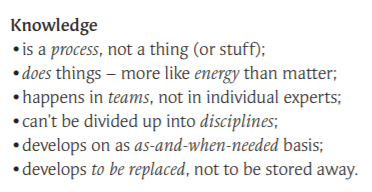
Before I started my teacher’s training I would have probably lumped the term “knowledge” in with learning, as something acquired in the process of learning. But in our lecture regarding Future Focussed Learning, Jane Gilbert explained that on her 20 years of “thinking on, and speaking about, the subject” she has come to see knowledge as a verb instead of a noun, and in her article “Catching the Knowledge Wave” she defines “knowledge” as follows:
(Gilbert, 2007, p6)
Yet, Bell (2010) when discussing teaching as a knowledge practice states that teachers need many kinds of “knowledges” (p27) to teach, including pedagogical knowledge, knowledge of the student, knowledge of their prior knowledge and even, to some extent, knowledge of their home life.
To be honest, faced with the idea of teaching students English, after many years of working out in the corporate and charity worlds, just because I had 300 level subjects in English, scared the bejesus out of me. I was worried that I would not have enough recent content knowledge that would satisfy (especially) the senior students who would be taking my classes. I had a degree that was cobbled together with some education papers completed in 1984, two thirds of a business (accounting and business law) degree that I ditched the third year of in the late 80s, various creative writing papers attempted part-time when my kids were little and a full-time go at actually acquiring a degree in 2012 – completing 11 papers in one year and ending up with – HOORAH! – a Bachelor of Arts in English. Talk about deep content knowledge – I think I only completed five papers at the 300 level in 2012, then I went back to working in accounting and administration for 7 years before I started my teacher’s training.
But I have come to realise that knowledge acquired over the many years I was not an English teacher have relevance, especially now where we are facing how to provide education in a knowledge economy. A recent discussion with a school principal suggested that people with a wider skill set are in hot demand in schools considering how to deliver education that is futures focussed. Another principal suggested I look into project based learning as she felt it would suit me, given that I come from a background of subjects that are seemingly disparate, but may become highly valued because I can bridge them. Gilbert talks about the “performativity” or utility of knowledge (p5) and that where it is most useful is in the spaces between things – the relationships and connections that can be made, the very act of enquiring into the void that stretches between already known things.
The English subject area of the NZ curriculum already supports this idea of knowledge and expects students to increasingly form connections across texts, across ideas, across audiences and attempt to make new sense of the world, form new meanings, and contextualise their learning within the framework of new knowledge. There is an expectation that while students are learning language features, structures and concepts that give them a taxonomy and vocabulary in English, they will also elevate themselves above the basics of what is happening in a text to how this has meaning and how this can be applied to other situations, relevant to their lives outside of school.
But what about if all subjects were like this? What would maths look like if we were to apply the knowledge to life situations, consider the physics of the shopping trolley and why it changes when one wheel won’t turn, how volume changes in a swimming pool during an earthquake, or how to perfectly set up the angles for potting the black ball at the end of a game of 8 ball? How much more engaging would maths be, if it was taken outside and explored as it related to every real world thing we did? Would kids learn less? I doubt it.
Our bodies contained knowledge the moment we arrived on the planet, or earlier, when we were cocooned in another human abdomen. We contain muscle memory, deep knowledge retained from learning to walk, talk, see, hear, smell, taste and touch. We are walking encyclopedias of potential, and we have at our disposal amazing opportunities to learn and gain new knowledges.
A agree to some extent with Gilbert when she says that change is needed and that some of the “sorting” features of education need to go. Of course students needs some disciplinary knowledge (p5) but they also need to encouragement to play with ideas, do their own research (not just rely on the teacher) and initiate their own projects. Schools need to produce, not just consume, knowledge, and develop new ways to deliver subjects that appeal to a differentiated student community – allowing more visual, aural and kinaesthetic expression and connection. Working together to scaffold knowledge and produce new knowledges and different models for presenting them. Diversity is key. Opportunities for difference should be rich (not scarce) and no teacher should rely on a one size fits all approach.
References:
Bell, B. (2010). Theorising teaching. Waikato Journal of
Education, 15(2), pp. 21-40.
Gilbert, J. (2007). Catching the Knowledge Wave. Education
Canada 47(3), 1-5.



 Wild Fishing in a Sea of Provocations