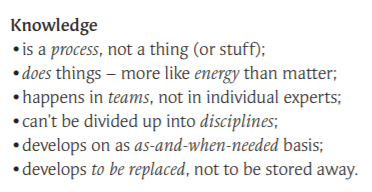
Before I started my teacher’s training I would have probably lumped the term “knowledge” in with learning, as something acquired in the process of learning. But in our lecture regarding Future Focussed Learning, Jane Gilbert explained that on her 20 years of “thinking on, and speaking about, the subject” she has come to see knowledge as a verb instead of a noun, and in her article “Catching the Knowledge Wave” she defines “knowledge” as follows:
Yet, Bell (2010) when discussing teaching as a knowledge practice states that teachers need many kinds of “knowledges” (p27) to teach, including pedagogical knowledge, knowledge of the student, knowledge of their prior knowledge and even, to some extent, knowledge of their home life.
To be honest, faced with the idea of teaching students English, after many years of working out in the corporate and charity worlds, just because I had 300 level subjects in English, scared the bejesus out of me. I was worried that I would not have enough recent content knowledge that would satisfy (especially) the senior students who would be taking my classes. I had a degree that was cobbled together with some education papers completed in 1984, two thirds of a business (accounting and business law) degree that I ditched the third year of in the late 80s, various creative writing papers attempted part-time when my kids were little and a full-time go at actually acquiring a degree in 2012 – completing 11 papers in one year and ending up with – HOORAH! – a Bachelor of Arts in English. Talk about deep content knowledge – I think I only completed five papers at the 300 level in 2012, then I went back to working in accounting and administration for 7 years before I started my teacher’s training.
But I have come to realise that knowledge acquired over the many years I was not an English teacher have relevance, especially now where we are facing how to provide education in a knowledge economy. A recent discussion with a school principal suggested that people with a wider skill set are in hot demand in schools considering how to deliver education that is futures focussed. Another principal suggested I look into project based learning as she felt it would suit me, given that I come from a background of subjects that are seemingly disparate, but may become highly valued because I can bridge them. Gilbert talks about the “performativity” or utility of knowledge (p5) and that where it is most useful is in the spaces between things – the relationships and connections that can be made, the very act of enquiring into the void that stretches between already known things.
The English subject area of the NZ curriculum already supports this idea of knowledge and expects students to increasingly form connections across texts, across ideas, across audiences and attempt to make new sense of the world, form new meanings, and contextualise their learning within the framework of new knowledge. There is an expectation that while students are learning language features, structures and concepts that give them a taxonomy and vocabulary in English, they will also elevate themselves above the basics of what is happening in a text to how this has meaning and how this can be applied to other situations, relevant to their lives outside of school.
But what about if all subjects were like this? What would maths look like if we were to apply the knowledge to life situations, consider the physics of the shopping trolley and why it changes when one wheel won’t turn, how volume changes in a swimming pool during an earthquake, or how to perfectly set up the angles for potting the black ball at the end of a game of 8 ball? How much more engaging would maths be, if it was taken outside and explored as it related to every real world thing we did? Would kids learn less? I doubt it.
Our bodies contained knowledge the moment we arrived on the planet, or earlier, when we were cocooned in another human abdomen. We contain muscle memory, deep knowledge retained from learning to walk, talk, see, hear, smell, taste and touch. We are walking encyclopedias of potential, and we have at our disposal amazing opportunities to learn and gain new knowledges.
A agree to some extent with Gilbert when she says that change is needed and that some of the “sorting” features of education need to go. Of course students needs some disciplinary knowledge (p5) but they also need to encouragement to play with ideas, do their own research (not just rely on the teacher) and initiate their own projects. Schools need to produce, not just consume, knowledge, and develop new ways to deliver subjects that appeal to a differentiated student community – allowing more visual, aural and kinaesthetic expression and connection. Working together to scaffold knowledge and produce new knowledges and different models for presenting them. Diversity is key. Opportunities for difference should be rich (not scarce) and no teacher should rely on a one size fits all approach.
References:
Bell, B. (2010). Theorising teaching. Waikato Journal of Education, 15(2), pp. 21-40.
Gilbert, J. (2007). Catching the Knowledge Wave. Education Canada 47(3), 1-5.

 Wild Fishing in a Sea of Provocations
I find it interesting that you talk about the read world application of subjects and knowledge as a verb: being more like energy or something one uses. I wonder what real world examples you could think of for Japanese to be used as. I feel as though I am in a similar boat to you in some ways. I only ever studied Japanese for the rich written language and I was not so interested in the speaking and listening. Other people I have met only study the language to get a job or for the interaction with people. Now I find myself in a classroom and all that knowledge that I built up for personal enjoyment has to be used. I have to listen to native speakers and I have to talk and model the language as much as possible for my students. Going into my first practicum I hardly spoke any Japanese and I was scared to and now I have gotten more used to it. My last practicum I was talking a lot which the EL picked up on. In short, I am seeing knowledge changing in my practice.
LikeLike